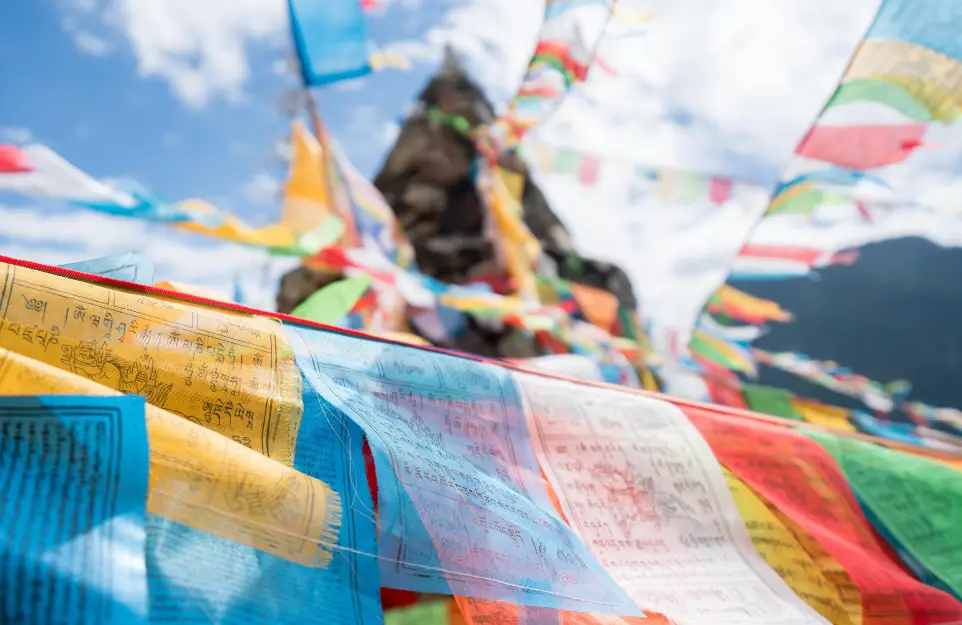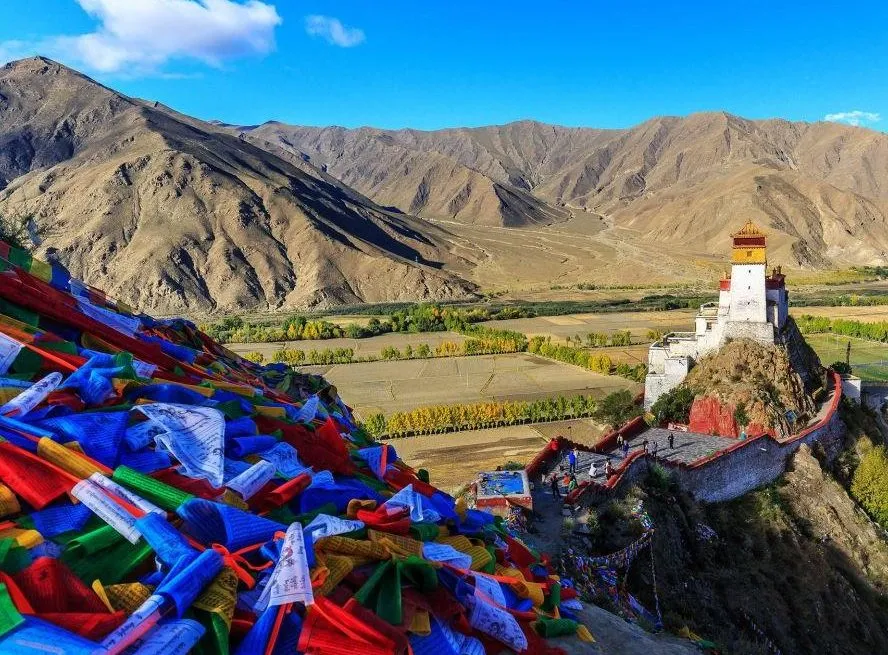
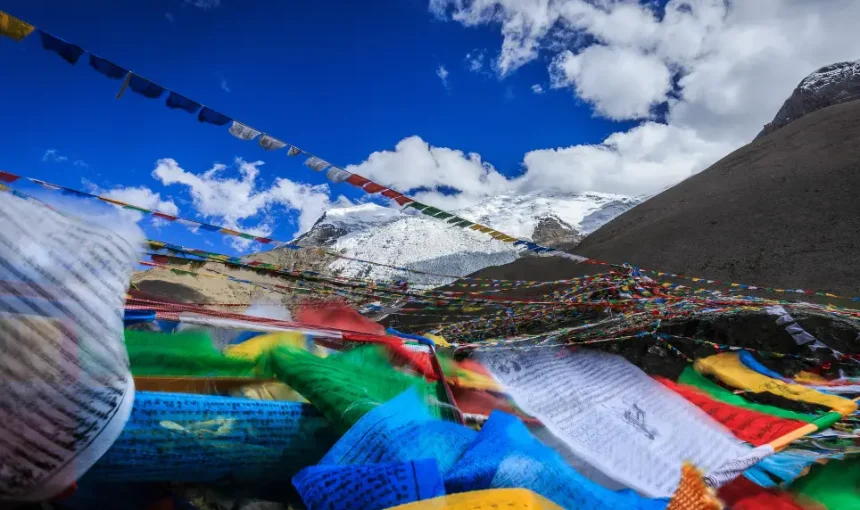
Traditionally, prayer flags are used to promote peace, compassion, strength, and wisdom. The flags do not carry prayers to gods, which is a common misconception; rather, the Tibetans believe the prayers and mantras will be blown by the wind to spread the good will and compassion into all pervading space.
Prayer flag:
In terms of its external form, we can roughly summarize it into three types:
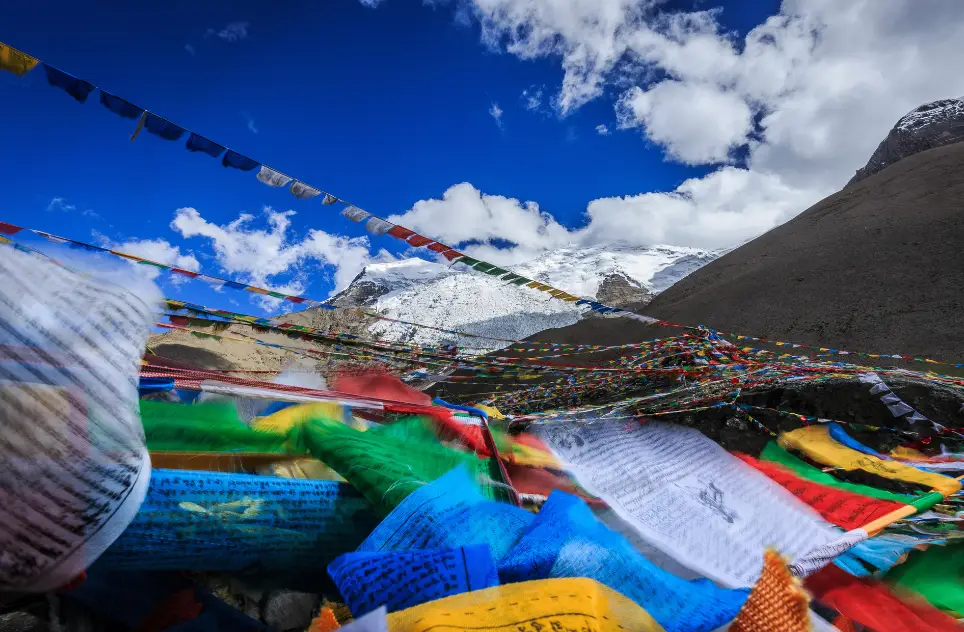
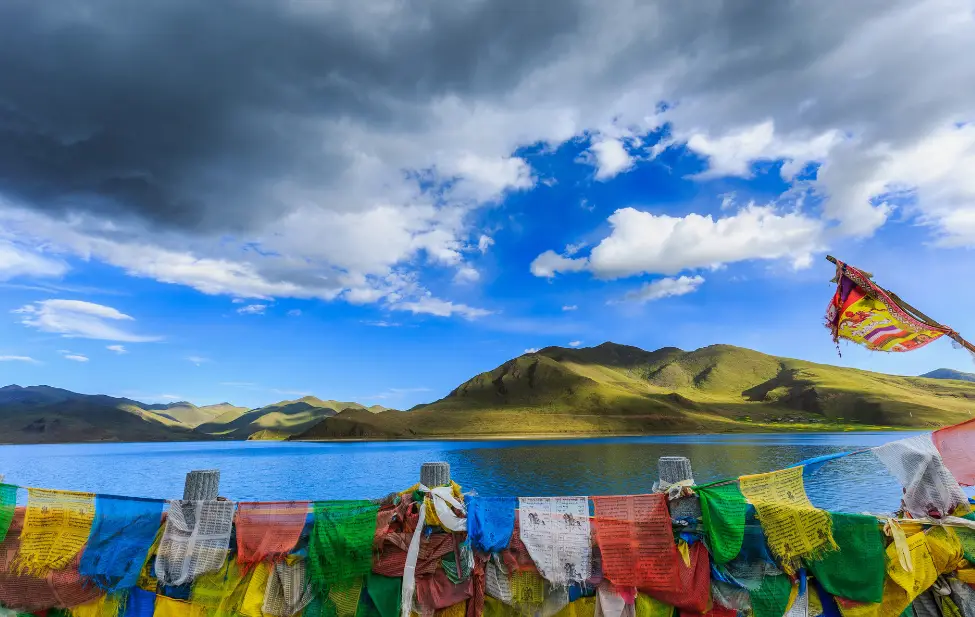
One is: blue, white, red, green and yellow squares of cloth printed with Buddha’s words and images of birds and animals are sewn one after another on a long rope and hung between two mountain tops. These prayer flags are commonly found on high mountains where there are few people.
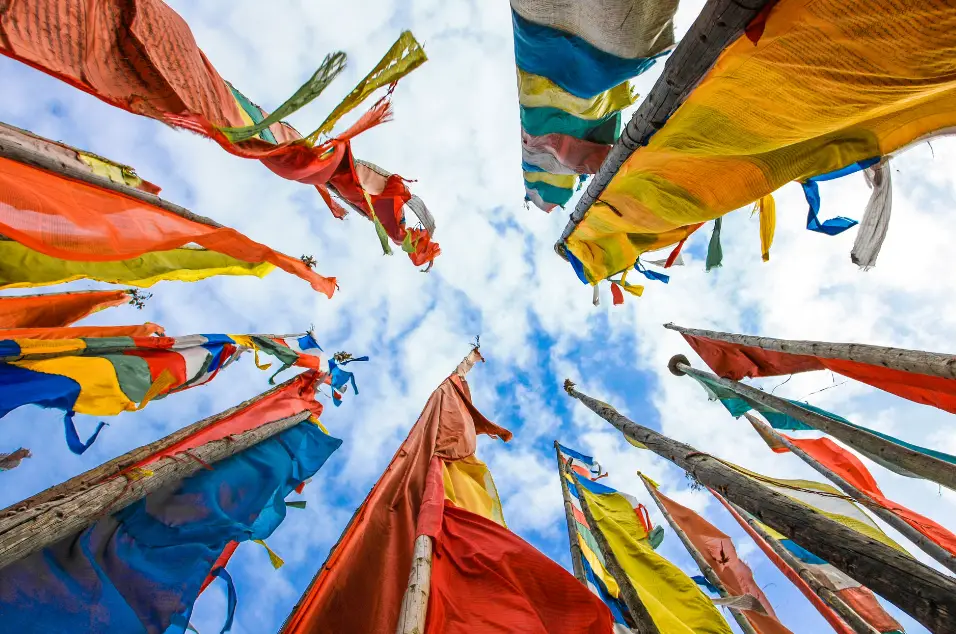
The second : The prayer flag is a three to five meters long strip of cloth, its color is a single, or white or red. Printed with the words of the Buddha, one side of the strip is sewn onto a thick pole and placed in front of the courtyard, such prayer flags are mostly found in the Gongbu forest area. The sutra pole inserted in the square of Jokhang Temple in Lhasa is of this kind, but it is more elaborate.
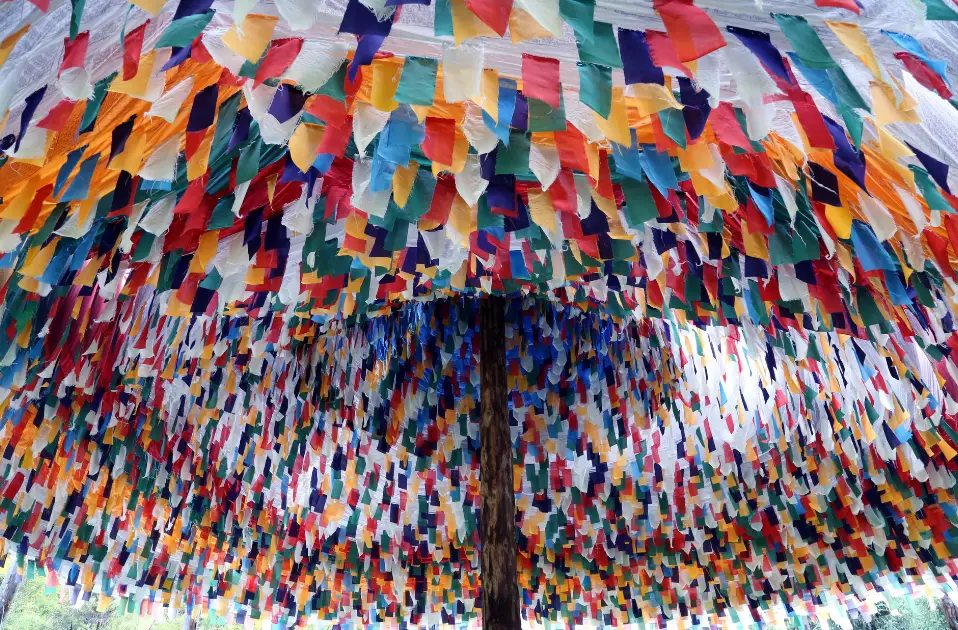
The third: five blue, white, red, green and yellow sparkle-less prayer flags and a monochrome border of the main prayer flag square cloth, printed with Buddha’s words and bird and animal patterns, these prayer flags are tied on willow branches, become prayer flags. These prayer flags can be seen on the rooftops of residential buildings in the ancient city of Lhasa.
The meaning of prayer flags
The various colors of prayer flags are fixed and cannot be randomly innovated. Secondly, the order of each color is strictly stipulated, and there can be no error. Because the meaning of prayer flags is very clear, not to beautify the environment, but to pray for good fortune and prosperity, to eliminate disasters.
Spark bar
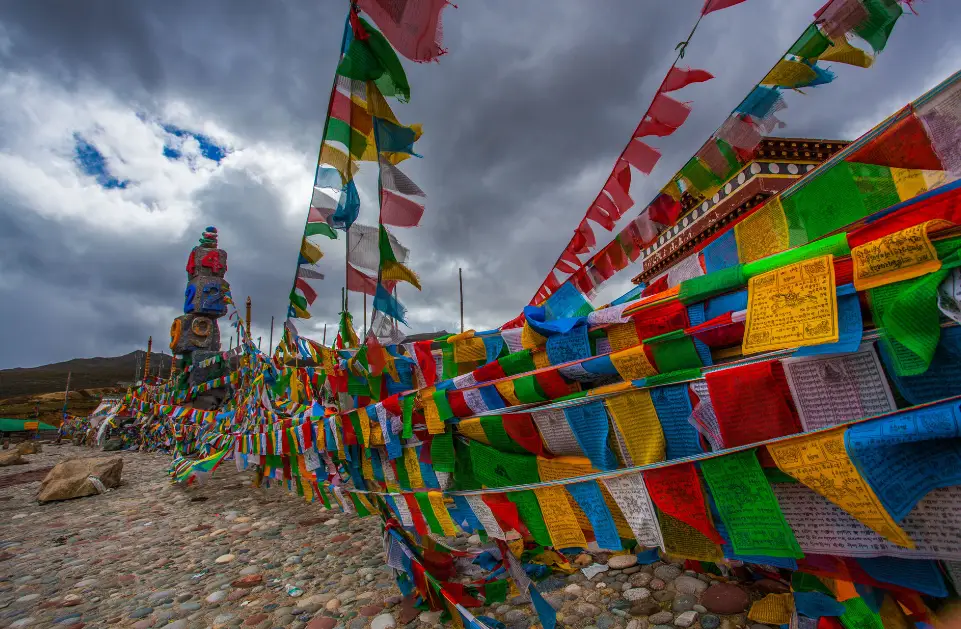
On the upper branches of the pole are lush spark bars, which are made up of five small flags of different colors. Generally, there are two to three groups of spark strips on a prayer flag according to the number of branches. The color arrangement of the five flags and the meaning they symbolize is this. At the top is the blue streamer, which symbolizes the blue sky; Below the blue flags are white flags, symbolizing white clouds; Below the white flags are red flags, symbolizing fire; Below the red flags are green flags in green water; The bottom streamer is yellow, symbolizing loess, or the earth. The arrangement of the five colors is exactly the three-dimensional arrangement of the material existence of objective nature, so, just as heaven and earth in nature cannot be reversed, these five colors cannot be misplaced.
Color meaning
The five colors symbolize the five phenomena of nature, which are the material basis of life. When the balance of nature is peaceful and the weather is good, the world is peaceful and happy. When natural disasters occur, human disasters abound and there is no peace. People who have lived on the plateau for generations are more sensitive to changes in nature. Looking forward to peace and happiness in the world, we should first hope that nature is free from disasters, so the five different colors of prayer flags are used to express this psychological support, which is really wonderful.

Graphic meaning
In addition to the symbolic meaning of the color of the prayer flags, there are also words and patterns. The dense Tibetan letters and lifelike patterns of birds and animals on the main prayer flags are printed on woodcut boards, and the Tibetan text can be seen as a Buddhist sutra. The text conveys meaning directly, unlike colors and lines, so you can read the text down to know its content. Since it is the Buddha who says that the Sutra cannot be separated from compassion, the main theme of purging all sentient beings. In addition to the text, it is difficult to know what the symbol of the Penglong lion tiger picture on the four corners and the treasure picture on the horse in the center is, so I have read a lot of materials, and Tibetan scholars at home and abroad have explained this in their works, but the most comprehensive and detailed is the Italian Tibetan scholar Mr. Nancanobu. The Tibetan scientist explains these images in the section on Wind Flags in his treatise on the South Kanobu Anthology (Tibetan edition, China Tibetology Publishing House). In the word (Ronda, wind banner), (Ronda) means heaven in the five kinds of earth, water, fire, wind and heaven. The original meaning of this word refers to big, all, all, if combined with other words to form a noun, such as (forest), (river) from the root meaning of these nouns can be seen to have a big, all, all meaning.