
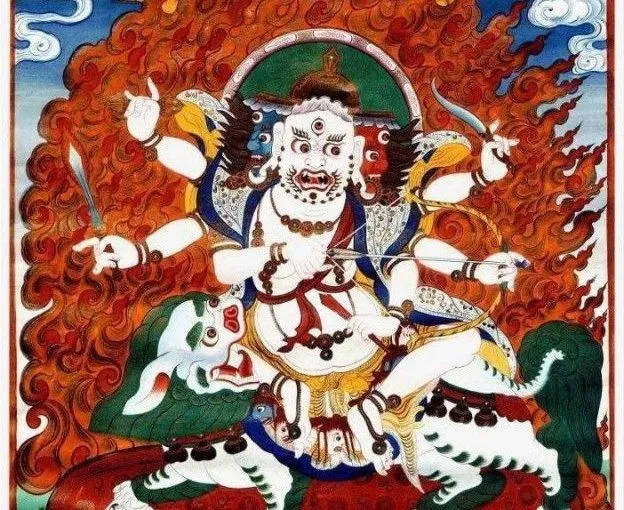
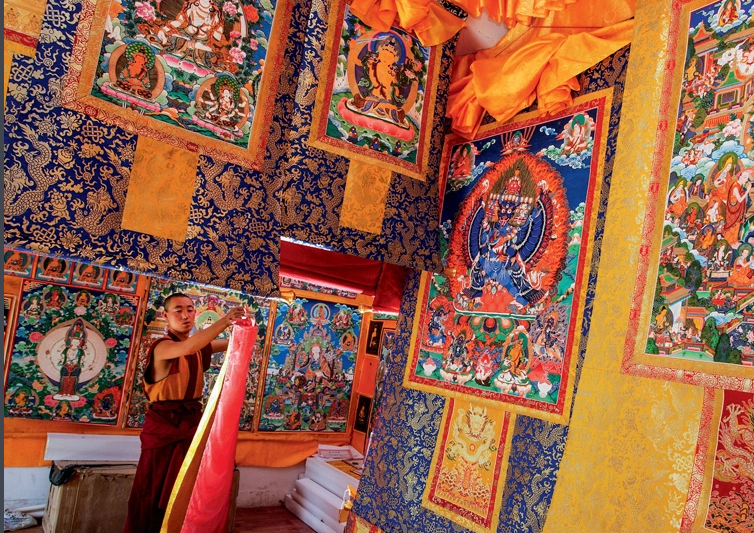
Thangka, also known as “Tangga” and “Tangka”, is a kind of colored scroll painting embroidered or painted on cloth, silk or paper. In the process of development, Gama Gachi painting school based on the tradition, bold innovation, absorb the essence of Han painters meticulous brushwork heavy color techniques, pay attention to lyrical freehand, pay attention to color contrast, form a rigorous structure, delicate painting characteristics.
On June 7, 2008, Tibetan Thangka (Qamdo Ga Ma Ga Chi Painting School) was approved by the State Council of the People’s Republic of China to be included in the second batch of national intangible cultural heritage list, heritage number XVII -14.
Historical origin
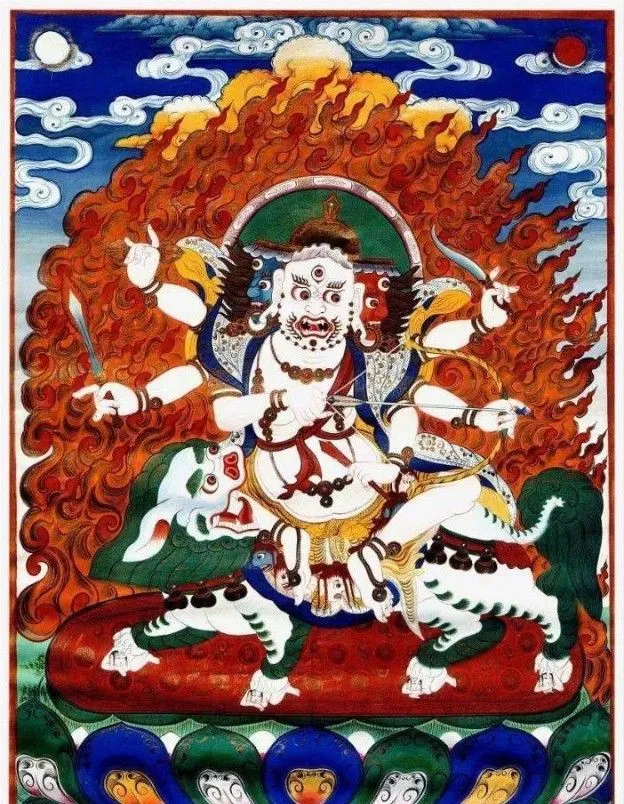
In the 16th century, the Kamaga School of painting began to prevail in Kham District. In the course of its development, because the region of its existence was closely connected with the Han Dynasty, it had relatively frequent exchanges in politics, economy and culture, especially in the aspect of painting, which was mostly influenced by fine brushwork heavy-color painting after the Han Dynasty and Mianzhu wood-block New Year pictures in Sichuan. On the basis of strictly inheriting traditional painting, Gama Gachi School of painting made bold innovation, absorbed the essence of Han painters’ meticulous brushwork and heavy colors, paid attention to lyrical freehand style, paid attention to color contrast, and rigorous structure. Its overall style formed the characteristics different from the two major painting schools of Miantang and Qinze in Weizang region.
Historical origin
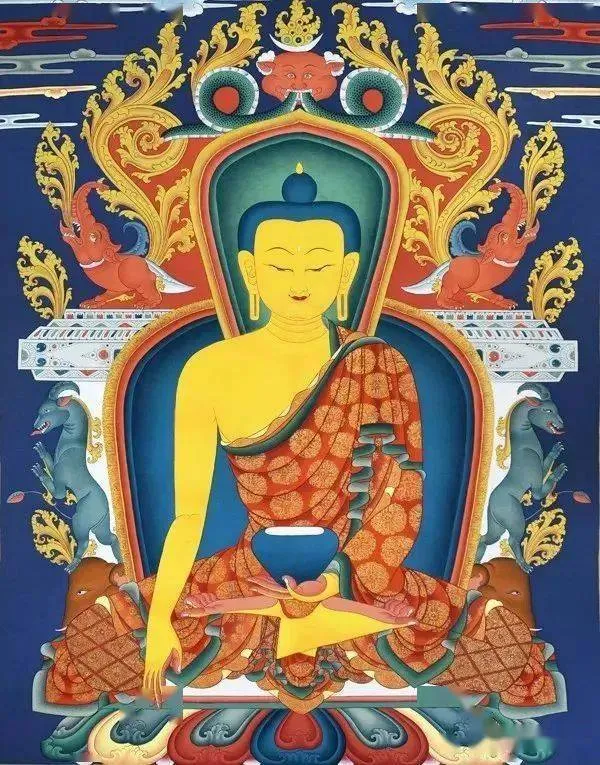
In the 16th century, the Kamaga School of painting began to prevail in Kham District. In the course of its development, because the region of its existence was closely connected with the Han Dynasty, it had relatively frequent exchanges in politics, economy and culture, especially in the aspect of painting, which was mostly influenced by fine brushwork heavy-color painting after the Han Dynasty and Mianzhu wood-block New Year pictures in Sichuan. On the basis of strictly inheriting traditional painting, Gama Gachi School of painting made bold innovation, absorbed the essence of Han painters’ meticulous brushwork and heavy colors, paid attention to lyrical freehand style, paid attention to color contrast, and rigorous structure. Its overall style formed the characteristics different from the two major painting schools of Miantang and Qinze in Weizang region.
At the beginning of the 20th century, the art of Gama Gachi school reached a more perfect and mature stage.
Cultural characteristics
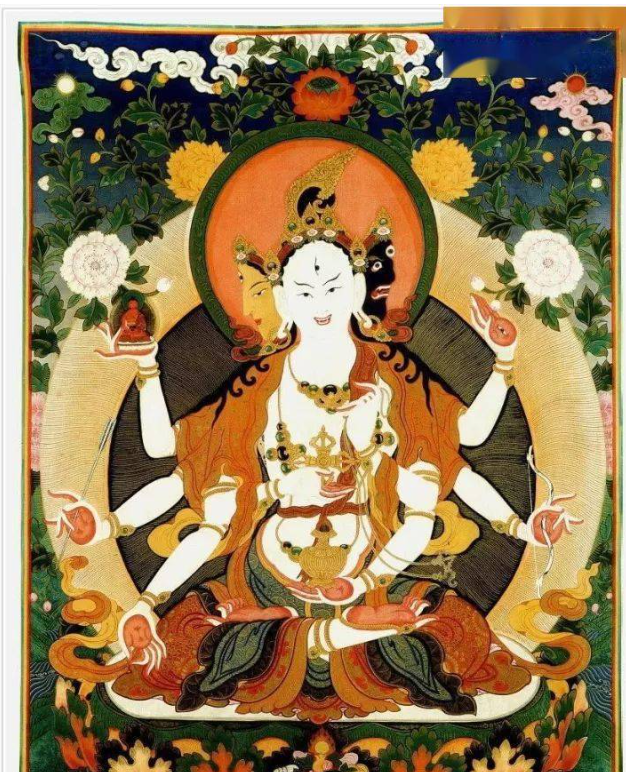
In the artistic expression, Ga ma Ga Chi painting school emphasizes individuality, casual, exaggerated, strong and smooth lines, quite skilled, elegant clothes, reflecting the free and vivid charm.
In the color of the work, the emphasis on the green tone, quite elegant and elegant, so that the picture produces a beautiful, magical artistic realm.
In terms of painting techniques, the Ga Ma Ga Chi painting school diluted the traditional smudging effect, paid attention to the shaping ability of lines, and adopted the interuse of warm and cool colors in the overall tone, which made the religious rendering and the decoration of the picture, the picture effect was magnificent, the color was strong, and the visual effect was strongly contrasted without losing the beauty and elegance. The overall hue has been changed from the early emphasis on blue-green to the emphasis on blue-green, and the coloring method has also been changed from the traditional flat painting to layer dyeing.
In the use of pigments, the Gama Gachi painting school mainly takes white, red, yellow, blue and green as the basic colors, and then changes into a variety of colors, according to the need for a large number of contrasting uses of these colors, and prefers to use high purity gold and silver, in order to make the picture colorful and rich decorative interest.
In the layout of the picture, the main characters are often used strong warm colors, and decorated with gold lines, and the depiction of the background can reflect the unique characteristics of the art of Ga Ma Ga Chi. The scenery in the picture mostly echoes each other with close, middle and distant scenes, with distinct layers and a certain perspective relationship. The depictions of mountains, waterfalls, flowers, birds, trees and other objects obviously draw on the expression techniques of Han Dynasty landscape painting in the Ming Dynasty. Under the foil of green mountains and water, blue sky, white clouds and snow peaks are interdecorated among them, so that the picture shows the fairyland of Tibet Plateau and creates a pastoral poetry.
Production process
Making Tools
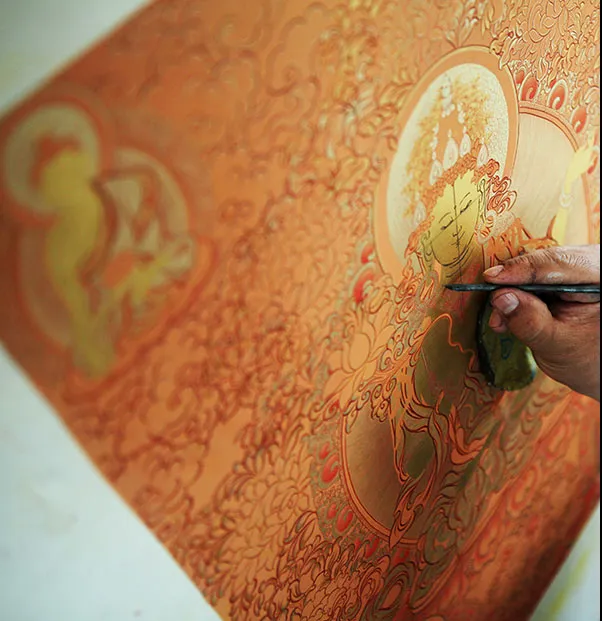
According to the different functions, the painting tools of Thangka are divided into supporting tools, measuring tools, paint containers, painting tools, modifying tools, polishing tools, etc.
Support Tools
Supporting tools include picture frame, string, easel, picture board, etc .
main classification
- By content: Buddha Thangka, biographical Thangka, historical Thangka, myth Thangka, catechetical Thangka, astronomical Thangka, calendar Thangka, Tibetan medicine Thangka, etc.
- According to size: large Thangka, ordinary Thangka, small thangka
- By material:
- Embroidery Thangka. Embroidered with multi-coloured silk, this thangka is tough and durable and is not easily damaged.
- Silk Tangka. With the method of “passing through the warp and breaking the weft”, the weft of various colors is woven in the pattern, and the warp is interwoven, and the carving stone and wood have a three-dimensional effect.
- Tapestry Thangka. The texture is mostly satin, and the weft is composed of various colors of silk, and it is woven with wrong jacquard, forming the required pattern, image and scenery.
- Stacking embroidery, also known as applique thangka. First cut each color satin into graphics (figures, birds and animals, trees, pavilions, flowers and plants, etc.), paste on the Thangka base material.
- Painting Thangka. Most are first painted on paper, cloth, cowhide, sheepskin, etc., and then made into thangka. Its basic painting form is no different from mural painting. Later painting thangka has developed, and some are engraved into printing plates, which can become “printed thangka”.
- Pearl Thangka. Pearl Thangka is a special kind of Thangka painting, and the number is very small. The Tara pearl Thangka in Changzhu Temple in Shannan, Xizang Province, is made of tens of thousands of pearls and art stones. It is stretch and elegant in shape and very expensive
Hand-painted Thangka is divided into: colored Tang (white background, painted with various colors), golden Tang (gold background), silver tang (silver background), red Tang (red background), black Tang (black background).
value and significance
historical value
Some thangkas are based on historical facts and focus on major political events and activities in history. Such as the performance of Songtsen Gambo’s life performance of historical themes. Among them, works that eulogize the friendship between Tibetan and Han nationalities, such as the story of Princess Wencheng’s entry into Tibet, will be painted in the prominent position of the temple. The picture depicts the historical events of the marriage of Tang and Tibet in Zhenguan 15 years through the scenes of Tang proposing marriage, the five difficult marriage ambassadors and the princess entering Tibet. The jubilant pictures in the Jokhang Temple and the Potala Palace reproduced the welcoming scenes of the Tubo people dressed in festive costumes, singing and dancing when Princess Wencheng arrived in Luasa. In the Potala Palace Hongsixi Pingcuo Hall, a picture of the Fifth Emperor’s visit to Shunzhi describes the various activities and welcome events of the Fifth Emperor’s visit to Beijing, audience, amusement and so on in 1652 AD
Religious value
The origin and development of Thangka is closely related to the rise and fall of Tibetan Buddhism. The rise and development of this painting art coincides with the introduction of Indian Buddhism into Tibet. At that time, nomadic life was still the main mode of production in many areas of Tibetan areas, and fixed temples alone could not meet the needs of many migrating believers. Therefore, thangka, an art mainly in the form of scroll paintings, meets the religious life needs of believers and becomes an idol that they can carry with them. Thangka, the art of painting, thus came into being and flourished. Some people also refer to Thangka as a “flowing mural” for its portability. Finally, the situation of “Tibetan monasteries are the halls of Buddhist painting art” was formed. Thangka’s prosperity depends on the prosperity of Tibetan Buddhism.
From the function of thangka, this art form mainly serves religious life. Monasteries are the centers of Tibetan religious culture, and most thangkas, especially some famous works, are mainly gathered in monasteries. Its main function is to hang for believers to worship, to meet their religious life needs. The thangka retained by the people is also mainly used by Buddhists to arrange their own sutras and Buddhist niches.
Economic value
Although thangka has a long history, it has not been a long time since Thangka really entered the collection market. In the early 1980s, when the Chinese art collecting market was just emerging, the price of thangka was usually only two or three hundred yuan. But since the 1990s, when Tibetan Buddhist art entered the collection market, the Thangka collection market began to heat up, and many thangka prices exceeded 1,000 yuan. Since 2006, because Thangka was included in the national intangible cultural heritage list, its collection has shown a very obvious warming trend, basically doubling the price every year. Although the price of thangka in China is getting higher and higher, compared with foreign countries, not only the overall price is low, but also belongs to the minority collection .
Ming and Qing Thangka began to appear in China’s auction market around 2000, when the auction price was generally about 10,000 yuan. In 2008, a “Medicine Master Buddha” Thangka by Ming Zhengde set an auction record of 15.4 million yuan . On November 26, 2014, Liu Yiqian, owner of Shanghai Long Art Museum, auctioned for HK $310 million the “Ming Yongle Imperial Red Hell Enemy Embroidery Thangka”, known as the “King of Thangka”, which began to flow to the West and first appeared at Christie’s auction in London in 1977, auctioned to an Indian collector for 7,000 pounds. It subsequently changed hands for $1 million in 1994. At Christie’s in Hong Kong in 2002, it set a new record of HK $30.87 million.
