Description:The Hexi Corridor is the main road of the Silk Road, but why there is no “silk gate” but “jade gate” in the Hexi Corridor. Two thousand years before the Silk Road was documented, the East-West cultural exchange line had been opened, but it was not for the export of silk, but for the import of Hetian jade.
Arriving in Xining, it is recommended to visit Dongguan Mosque, Qinghai Museum and other places. In the evening, you can also go to the 600-year-old Xining Old Street Mojia Street to taste the special food, such as stuffed skin, yogurt, noodles, lamb kebabs and so on!
Dongguan Mosque is one of the four famous mosques in northwest China.
(280KM sea dial :2730 meters), starting from Xining, over the Qilian Mountains, through the shooting of the scenery of the Black Spring reservoir, climb the Dabanshan observation platform, and shoot the beautiful Gangshika snow peak under the sea of 100 li rape flowers.
In the afternoon, I passed through the beautiful Qilian Mountain pasture, under the blue sky and white clouds, green grass, wildflowers in full bloom, herds of cattle and sheep.
Then came to the beautiful scenery of A Rou prairie, where there is a resplendent A Rou Temple, this ancient temple was established in the Ming Wanli years, in the Qing Daoguang years to rebuild the temple, is now the largest Gelugpa monastery in Qilian County, here is simple and quiet, almost no foreign tourists to visit.
(232KM sea dial :1717 m) Today to the Zhuoer Mountain near Qilian County, the Zhuoer Mountain scenic spot Qilian County Babao Town, close to the Babao River and the Tibetan sacred mountain Amidongsoo (Niuxin Mountain) across the river. Zhuoer Mountain belongs to Danxia landform, composed of red sandstone and conglomerate. In Tibetan, it is called "Zongmu Ma Yumma", which means the beautiful red queen.
Standing at the top of the Zhuoer mountain, the vision is extremely open, there is no barrier around the mountain, the opposite side of the mountain is a mountain with the scenery of the four seasons, the left and right sides are the Lagong Gorge and Baiyang Ditch scenic spot, the back is the rolling Qilian Mountain, and the eight Treasures River at the foot of the mountain is like a white hada around the county. Everywhere beautiful scenery, like a fairyland, refreshing.
After the tour of Zhuoer Mountain, drive to Zhangye, a historic and cultural city, and focus on Zhangye Danxia Geopark, which is the only combination of Danxia and colorful hilly landscape in China, and was rated as the world's top ten magical geographical wonders by National Geographic magazine.
(577KM sea dial :1145 m) from Zhangye via Jiuquan to Jiayuguan City, here the focus is on Jiayuguan scenic spot, Jiayuguan, known as "the first mighty Pass under the heaven", the wall on both sides of the pass across the desert Gobi, north of the mountain overhanging wall, south of the first block, is the western most pass of the Ming Great Wall.
Jiayuguan Pass was once known as the throat of Hexi in history, because of the dangerous terrain, magnificent architecture, known as the key to the border, Jiayuguan Pass is the ancient Silk Road traffic fortress, one of the three wonders of the Great Wall of China (Shanhaiguan Pass in the east, Zhenbeitai in the middle and Jiayuguan Pass in the west).
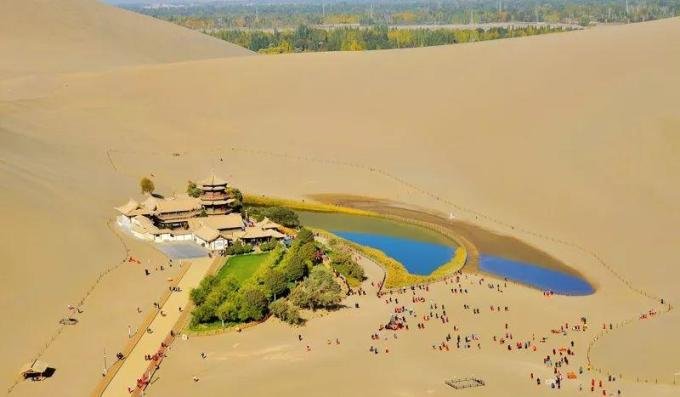
In the afternoon, we arrived at Dunhuang. Dunhuang is located on the main road of communication between ancient China and the Western regions, Central Asia and Europe. It has a long history and splendid culture and is the most famous important town on the ancient Silk Road.
In the evening, you can go to the famous Shazhou market in Dunhuang and taste the local specialties
Today, go to the famous Dunhuang Mogao Grottoes, also known as the "Thousand Buddha Cave", the grottoes are distributed from south to north with a total length of more than 1600 meters, up and down 5 layers. It was first built in the second year of Jianyuan of the former Qin Dynasty (366), and has been built in all dynasties. By the time of Wu Zetian of the Tang Dynasty, there were more than 1,000 caves. After thousands of years of natural and man-made destruction, there are still 492 single caves.
There are more than 45,000 square meters of murals, more than 2,400 pieces of colored sculptures, and five wooden structures in the Tang and Song Dynasties. The art of Mogao Grottoes is a comprehensive art that integrates architecture, colored sculptures and murals. It is the largest and most famous Buddhist art grotto in China, and it is also the largest and richest Buddhist art holy place in the world.
(475KM sea: 2686 m) In the morning from Dunhuang, along the desolate and magnificent Gobi highway, through Aksai and then over the Dang Jinshan pass (sea: 5400 m), you will enter the South Baxian Yadan landform group protection area.
South Eight immortals is a geological movement raised out of the water, during which the salt and sand coagulation of the crust was eroded by the west wind sculpture, due to the strange terrain generated by the mysterious wind, coupled with the local rocks rich in iron, strong magnetic field, often make the compass fail, resulting in the loss of direction, the world is regarded as the devil city, is the largest wind-eroded soil forest group found in China so far. It is also one of the largest and most typical Yadan landscapes in the world.
In the afternoon, we arrive at the world's only aquatic Yadan landform, because the rise of Lake Ginelle gradually submerged the Yadan group on the northern edge, forming a unique aquatic Yadan.
Water Yadan is surrounded by endless Gobi Beach, in this desert land, water Yadan is like a natural art, a variety of beautiful and mysterious.
(230KM sea dial: 3,200m) In the morning, facing the sunrise along the road in the Gobi all the way to the east, in the morning, we went to the tourist agencies do not go to the small scenic spot, located in the deep Qaidam Basin beautiful Jade Lake.
The jade Lake is actually the mining area of the salt lake mining team of the former Daqaidan Chemical plant, and the mining pit formed by the mining of the salt lake for many years has formed the beautiful jade Lake with different forms and different depths.
The beautiful jade Lake also presents different colors in different light, because this is not a regular scenic spot, so tourists and vehicles are relatively few, and you can quietly shoot your own satisfactory works.
After visiting the beautiful Jade Lake, we then passed Delingha to the Chaka Salt Lake in Wulan County. The Chaka Salt Lake is sandwiched-between Wanyan Tongbu Mountain, the branch of the Qilian Mountains, and Wangashu Mountain, the branch of the Kunlun Mountains. The two mountains are covered with snow all the year round, and the snow mountains are reflected in the lake surface, forming a unique natural scenery of the Qinghai-Tibet Plateau where water and sky meet, and the salt lake and snow peaks complement each other.
The salt lake waters are wide, silver sparkling, surrounded by grass such as Yin, sheep like pearls, the sky is white, distant Cangshan lofty, blue sky and white clouds, snow mountains into the lake, picturesque. So it is also known as the "mirror of the sky" in China.
After enjoying the dreamy sunset at Chaka Salt Lake, return to Chaka Town Hotel.
(295KM sea: 2260m) from Yanka Salt Lake to beautiful Qinghai Lake, Qinghai Lake named "Tsowunbu" in Tibetan (meaning "blue sea"), formed by the fault collapse between Datong Mountain, Riyue Mountain and Qinghai Nanshan Mountain in the Qilian Mountains, is China's largest inland and saltwater lake.
Qinghai Lake has been "China National Geographic" as "the most beautiful lake in China" first, in summer, Qinghai Lake, surrounded by 10,000 acres of golden rape flowers and beautiful alpine pastures, constitute the most unique magnificent scenery of Qinghai Lake.
Blue sky, green lake, golden rapeseed flower sea.
In the afternoon, along the south line of Qinghai Lake, enjoy the picturesque scenery along the way, and return to Xining with a pleasant mood.
This is the first day in Tibet. Your guide will greet you at Lhasa Gonggar Airport/Railway Station and transfer you to your hotel. It usually takes around 1 hour to drive from Lhasa Airport to downtown Lhasa and takes about 20 minutes from Lhasa Railway Station. Tourists could have a look at the Yarlung Tsangpo River, the largest and longest river in Tibet on their way to the hotel. After check-in, you can have a good rest first. And if you feel like going out, you can wander around the city. But just remember that don't take too much stuff, try to go with a light pack. Meanwhile, drink some more water, and do not move strenuously. It’s really useful to get acclimatized to the high altitude.
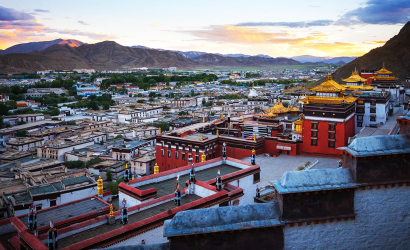
In the morning your guide will meet you at the hotel and take you to visit the famous Potala Palace, the cardinal landmark of Tibet and the masterpiece of Tibetan architecture. It was first built by the 33rd King Songtsen Gangpo in the 7th century and rebuilt later by the 5th Dalai Lama in the 17th century. Now it is a museum and world heritage site.
In the afternoon, we will go to visit Jokhang Temple in the center of the old Lhasa city. Jokhang Temple is the most sacred temple in Tibet and it is always bustling with earnest local pilgrims since the early days. After that, you will take a walk around the Barkhor Street which is one of the most devotional circuits as well as a crowded central market of Lhasa. Barkhor Street is a very ancient round street surrounding the Jokhang Temple and the locals are always proud of it. As a symbol of Lhasa, it is also a must-see place for visitors.
Today’s first attraction is Drepung Monastery. Drepung means "piles of rice" in Tibetan, which symbolizes prosperity. It's the world's largest monastery that housed more than 10,000 monks in the past. Also, It's the highest-ranking monastery in the Gelug Sect. After lunch, you will continue to visit the Sera Monastery, the most beautiful Tibetan monastery in Lhasa. The Buddhist scripture debating is the highlight of Sera Monastery.
Your tour ends today. Our guide and driver will collect you from your hotel to transfer to Lhasa Airport/Railway Station for your next destination.