Description
Tibet, a mysterious and holy land, attracts countless tourists with its unique natural scenery and profound cultural heritage. If you want to fully appreciate the charm of Tibet in a short time, it is very important to choose a suitable tourist route. This article will recommend you a 5 days must visit route in Tibet carefully designed by experts. It will comprehensively analyze the itinerary, accommodation and scenic spots to help you travel in Tibet easily.
5 Days Cultural and a day trip Hiking Tour; (G03)
Tibet, a mysterious and holy land, attracts countless tourists with its unique natural scenery and profound cultural heritage. If you want to fully appreciate the charm of Tibet in a short time, it is very important to choose a suitable tourist route. This article will recommend you a 5 days must visit route in Tibet carefully designed by experts. It will comprehensively analyze the itinerary, accommodation and scenic spots to help you travel in Tibet easily.
Lhasa City,Drepung Monastery ,Sera Monastery, Jokhang Monastery,Reding Monastery,
- Samdenling Nunnery,Yamdrok Lake
5 Days Cultural and a day trip Hiking Tour
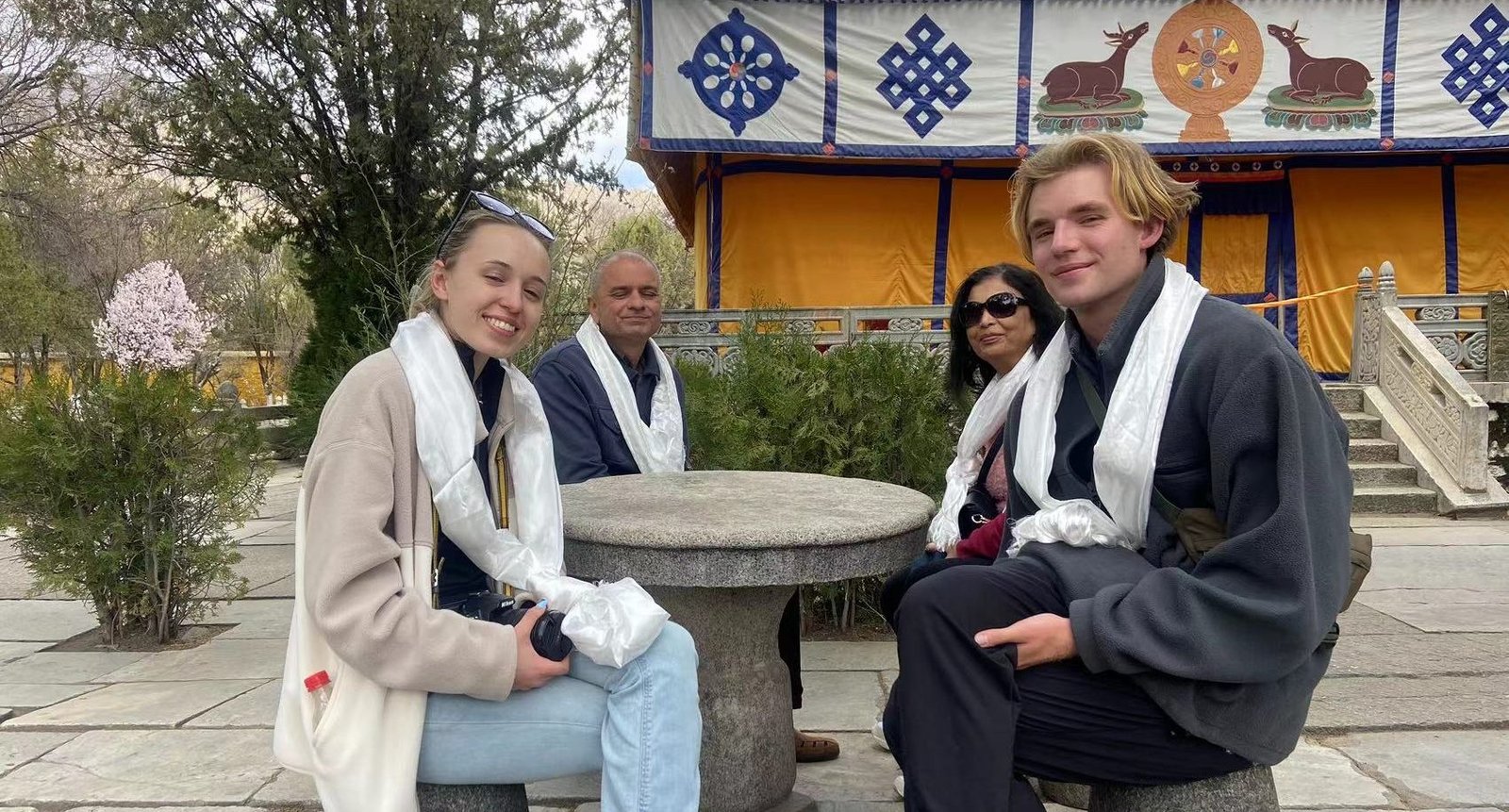
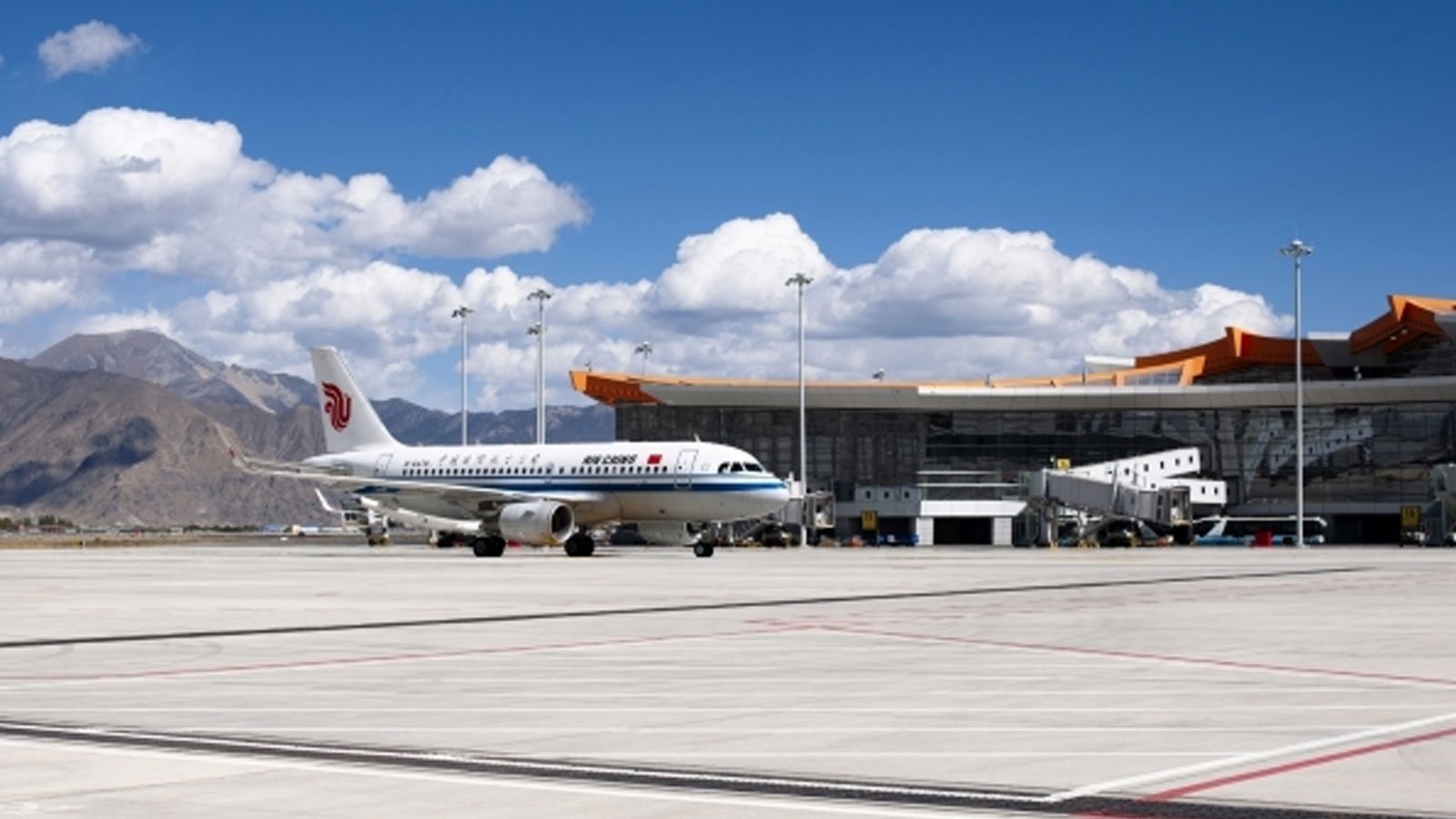 Our Tibetan guide and driver will greet you at the airport or train station and present you with a Kada (the traditional Tibetan ceremonial white scarf) to Welcome you to Tibet :) Then will be drive around 40-50 minutes to Lhasa city if you take plane to Lhasa or drive 20 minutes to Lhasa city if you board train to Lhasa and transferred to your hotel. Along the way, you can enjoy the spectacular scenery of Yarlung Tsangpo River, Lhasa River, and the typical Tibetan villages and highland barley seeds farms.
Later your guide will introduce you to the other members of your group once all are in Lhasa. And will discuss about tour schedule in Tibet. Then will show you some of local, Chinese and continental dish restaurants for the dinner. On your arrival of the first day must be take an easy, relax and keep hydrated by drinking warm water or home temperature water. Will be very helpful to acclimatize to the high altitude.
Overnight at Lhasa.
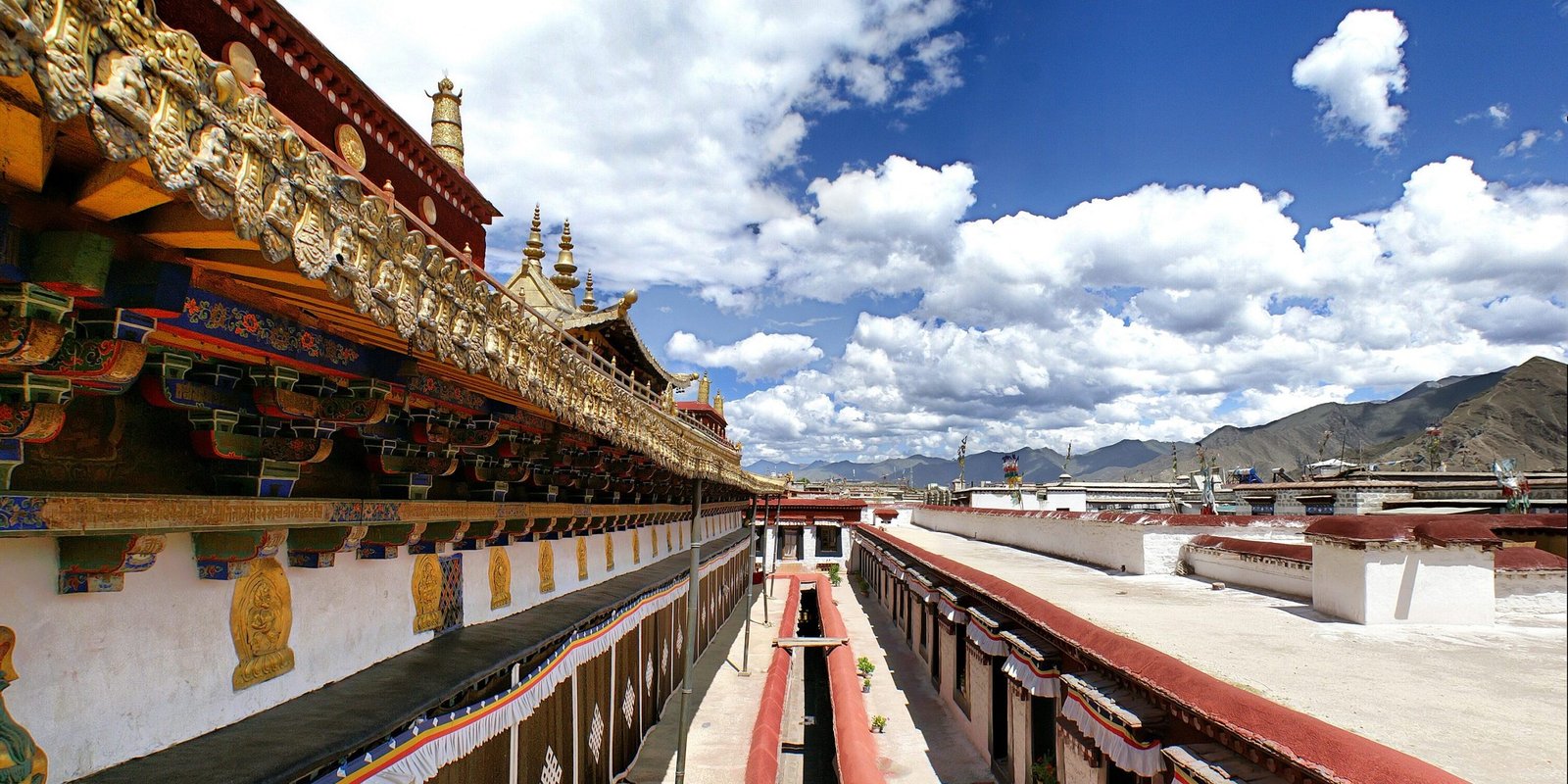
 Attraction; Drepung Monastery , Sera Monastery. Guide will arrange your Lunch with local taste in monastery restaurant;
After the breakfast our driver and guide will pick you up from hotel and drive to the monasteries. Today, you will visit Drepung and Sera monastery from morning around 9:00 to 5:00 pm. Both of monasteries offering a unique insight into Tibetan Buddhism. And will also have local food taste from the monastery restaurant
History of Drepung Gompa
Drepung monastery is one of the six major monasteries of Gelukpa order. Drepung, Ganden and Sera Monastery are known as the three major and highest ranking monasteries in Lhasa. It was once one of the world’s largest monastery where in the pass day there were over 10,000 monks who studies as well as lives in there. It was a town itself at time Drepung is Tibetan name which means heap of rice. It is located in a valley on the southern slope of Mount Genpuwuzi, about 8 kilometers to the west of central of Lhasa city. It was founded in 1416 by the Jamgyang Choejee Tashi Paldan the disciple of the founder of the Yellow Sect, Tsongkhapa master. There are countless halls in Drepung monastery with the most famous being the "Jampa Thongdorl" hall in religious terms and the most important being the "Ganden Potang" hall in political terms. The "Jampa
Thongdrol " (Maitreya Sees Liberation) Hall is located on the northwest side of the third floor of the Tsochen Hall. Although it is not large in scale, it is famous for its main statue of Maitreya at the age of eight. A continuous stream of believers came to worship. Inside the hall, there is also the precious treasure of the temple - the white conch was bless by the Budhha Shayakmuni when he was in India . When Tsongkhapa ordered Jamyang Choejee Tashi Paldan to build the Drepung Monastery, he would hand over the white seashells personally excavated by Tsongkhapa before the construction of Ganden Monastery to Tashi Paldan and wish the temple a success. This collection of seashells has always been kept in the Maitreya Hall. There are also six main scripture halls in the temple: 1. Ganden Podang Chapel 2. Tsochen Hall 3. Tantric Monastery 4. Losaling collage 5. Guomang collage 6. Deyang collage.
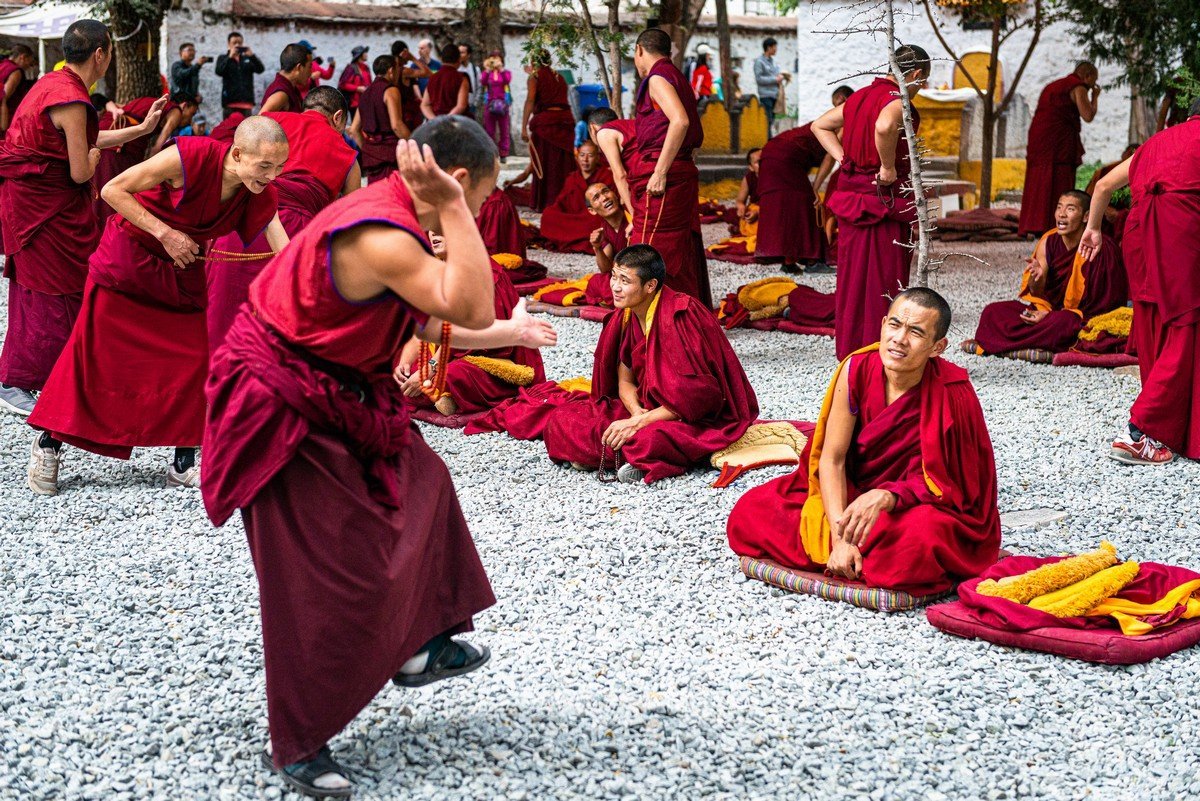
After around 3 hour’s visiting of the Drepung Gompa will have a 1 hour lunch time for locate taste from the monastery restaurant then drive to next scenic spots. The most interesting thing in the Sera Gompa is Buddhist philosophy debate. The debate venue of Sera Monastery is part of the traditional learning method of the Gelug sect of Tibetan Buddhism, and the debate ceremony starts at 3 pm to 5 pm from Monday to Friday. When debating scriptures, monks usually sit on the ground while another stands across from them, exaggerating their movements to debate the scriptures. This is a discussion of Buddhist knowledge and also a way for lamas to learn. The debate ceremony of Sera Monastery is well-known in Tibetan areas and attracts many tourists to visit. Except for special holidays, the debate venue holds debate activities from Monday to Friday, giving visitors the opportunity to witness this unique form of religious learning firsthand.
History of Sera Gompa
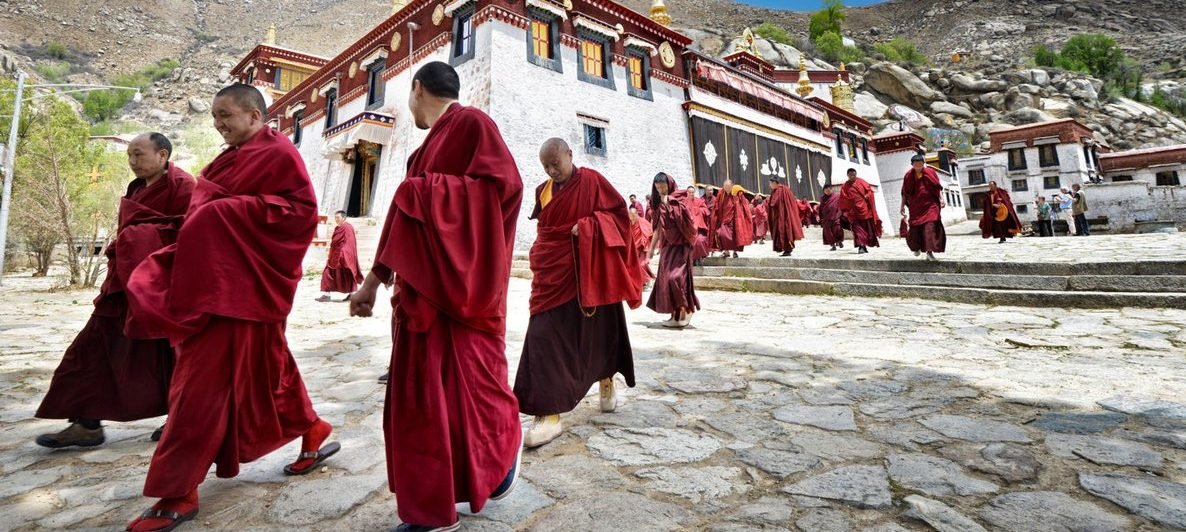
Sera Monastery, also known as Sera Mahayana Monastery, is one of the six main monasteries of the Gelug sect in Tibetan Buddhism. Along with Drepung monastery and Ganden monastery, it is known as one of the three major temples in Lhasa and is the latest one built among them. Sera Monastery is a national key cultural relic protection unit, located at the foot of Sera Uzi Mountain, 3 kilometers north of central part of Lhasa city. It is surrounded by willow forests and has been a place for high monks and living Buddhas to preach since ancient times. There are many small monasteries for monks and nuns surrounding it. In the 17th year of the Yongle reign of the Ming Dynasty (1419), Jamchen Shakya Yeshi, a disciple of Tsongkhapa master, built it, which was completed in the 9th year of the Xuande reign of the Ming Dynasty (1434). Later, Jamchen Shakya Yeshi was summoned to Beijing and granted the title of Great Compassionate Dharma King. After returning to Tibet, the imperial bestowed sutras and statues were preserved in the temple and still exist today. At its peak, there were over 8000 monks in the monastery, slightly smaller in scale than the Drepung Monastery. There are tens of thousands of Vajra statues in the Sera Gompa, most of which are made locally in Tibet. There are also many bronze Buddha statues brought from mainland China or India. The walls of the main hall and various Tazang scripture halls preserve a large number of original colored murals. The most famous statue is the " Protector Hayagriwa " statue in the main hall. The main buildings include Tsochen (Assembly Hall), Jee Tazang, Mai Tazang, Ngapa Tazang, and 32 Kang Tsan villages. The early buildings were centered around Mai Tazang and Ngapa Tazang , and were later expanded and renovated throughout history to have the current scale, so there was no overall plan for the layout. But the architecture of Sera Monastery is dense but not crowded, diverse but not chaotic, tailored to local conditions, with a prominent main body, reflecting the unique style of Gelugpa monasteries, and is entirely a religious city.
Breakfast, Lunch
Overnight at Lhasa
Attraction; Potala Palace, Jokhang temple and Bakhor Street;
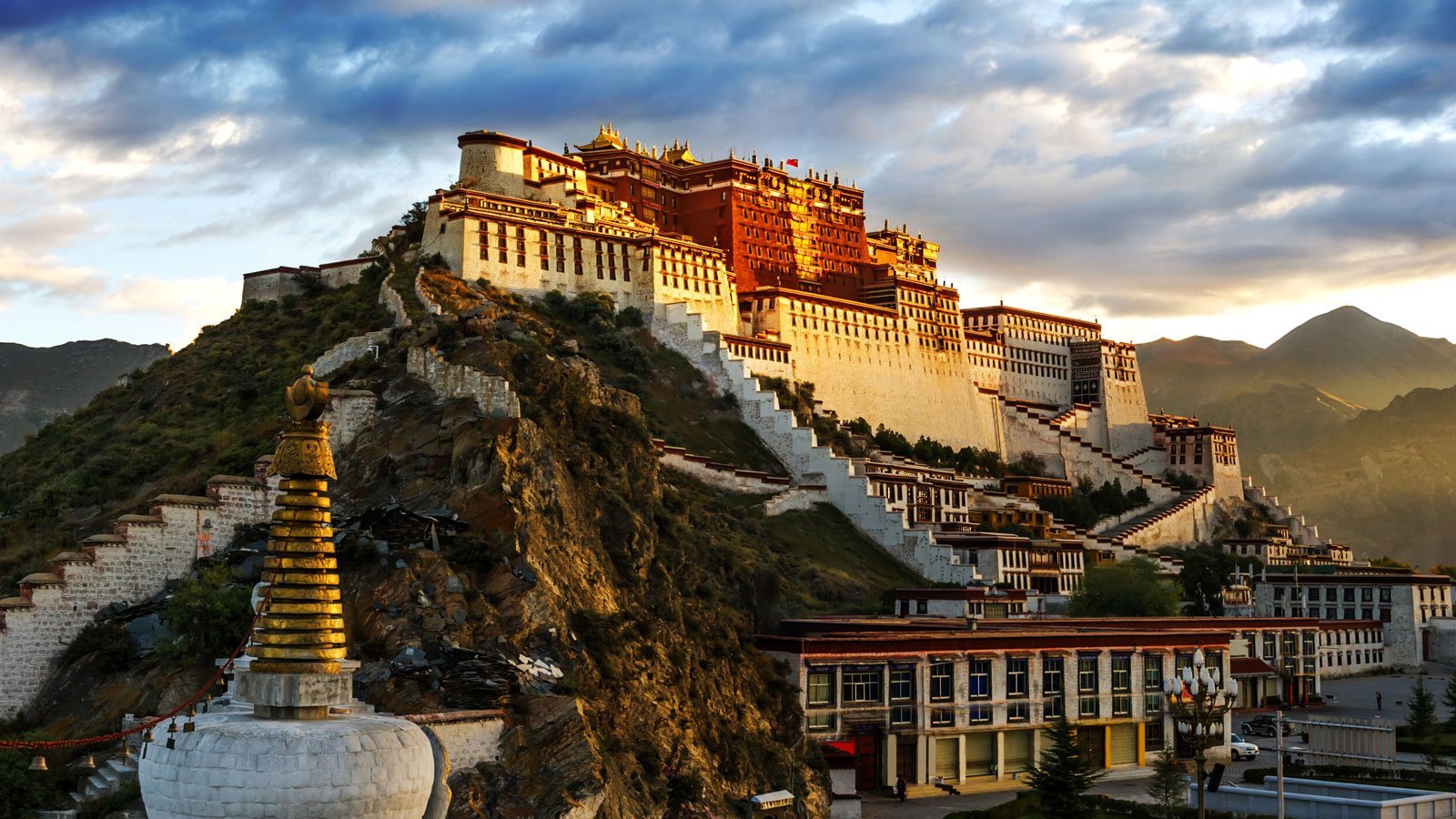
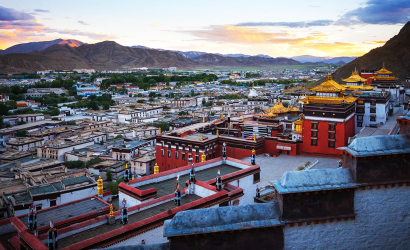
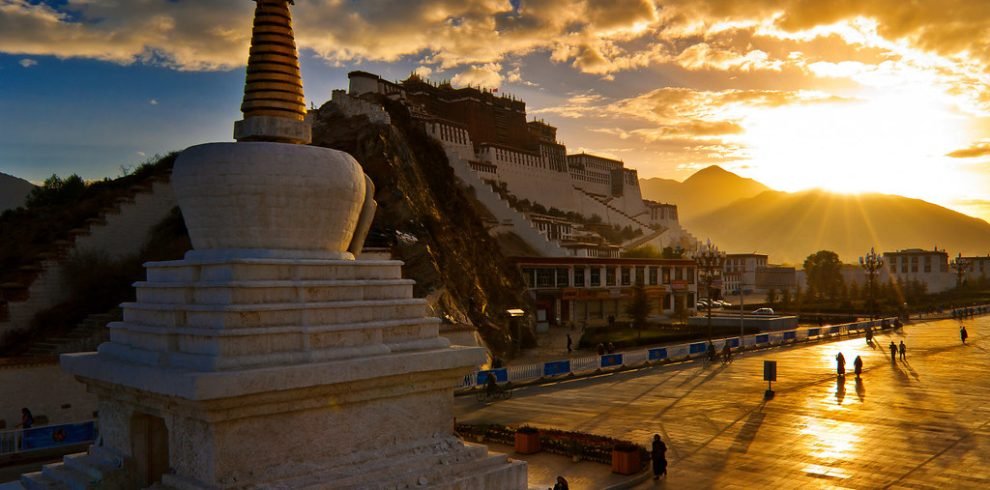
In the morning, your Tibetan guide and driver will meet you and the other group member at hotel lobby then start from downtown Lhasa and first visit the Potala Palace, which is not only the political, religious and cultural center of Tibet but also the holy land of Tibetan Buddhism.
History of Potala Palace or ancient castle
The Potala Palace is located on the Maburi Mountain (Red Mountain) in the northwest of Lhasa, the capital of the Tibet Autonomous Region of the People's Republic of China. The Potala Palace was built under the leadership of Songtsen Gampo, the 33rd Tibetan king of Tubo, in 631 AD. However, with the disintegration of the Tubo Kingdom, it suffered severe damage due to natural and man-made disasters. In 1645, the Fifth Dalai Lama rebuilt the Potala Palace to consolidate the political and religious unity of the Ganden Pohang region, and continued to expand it until it reached its current size. The Potala Palace was designed and built according to the layout of Buddhist mandalas, covering a total area of over 360000 square meters and a total construction area of over 130000 square meters. The main building is 117 meters high and has 13 floors. It is a large palace style architectural complex with 1267 rooms, including palaces, stupas, Buddhist halls, administrative offices, monk schools, and monk houses. The main works of the building have two systems: the White House and the Red Palace. The White House is the place where the Dalai Lamas of past dynasties govern and live. The Red Palace is the place for religious activities and the place where the Dalai Lamas of past dynasties worship their stupas. The building form of the White House around the Red Palace reflects the social system of the integration of politics and religion in old Tibet. After 1959, the Central Committee of the Communist Party of China and the State Council attached great importance to the maintenance and protection of the Potala Palace, and allocated maintenance funds throughout the year. Two phases of maintenance were carried out in 1988 and 2001. On March 4, 1961, the Potala Palace was announced by the State Council of the People's Republic of China as the first batch of national key cultural relics protection units. In 1994, the Potala Palace was listed as a World Cultural Heritage site by UNESCO. Potala Palace is the winter palace of all previous Dalai Lamas, and also the ruling center of the integration of politics and religion of Tibet’s m local rulers in the past. Since the fifth Dalai Lama, major religious and political ceremonies have been held here. At the same time, it is a place to worship the spiritual tower of all previous Dalai Lamas.
Afternoon we will go to Jokhang Temple to experience the strong religious atmosphere. Then we will stroll along Barkhor Street, taste authentic Tibetan cuisine, and purchase handicrafts. In the evening, you can go to see the night view of the majestic Potala Palace to enjoy the beautiful night walk.
History of Jokhang temple
Jokhang Temple, located in Lhasa, Tibet Autonomous Region, is a central Tibetan Buddhist temple and also a central of the universe too. It was founded in 647 A.D. by the Tibetan King Songtsen Gampo to commemorate Princess Wencheng's entry into Tibet. Jokhang Temple has a long history of more than 1300 years. It is one of the most splendid existing buildings in Tibet during the Tibetan period and the earliest civil structure building in Tibet. The temple was originally called "Rasa", later evolved into "Lhasa", and eventually became the name of the city. Jokhang Temple is not only a Buddhist temple, but also a three-dimensional representation of the ideal model of the universe in Buddhism - the mandala. The architectural style of Jokhang Temple combines the characteristics of Tibetan, Tang, Nepalese, and Indian architecture, and is a model of Tibetan religious architecture. There are statues of Shakyamuni and other figures enshrined in the temple, as well as statues of Songtsen Gampo, Princess Chizun, and Princess Wencheng. The temple has undergone multiple expansions and modifications, especially during the Yuan, Ming, and Qing dynasties, forming its current scale. Jokhang Temple is not only a pilgrimage site for Tibetan Buddhists, but also a sacred temple revered by various sects. The "Golden Urn Lottery" ceremony for the reincarnation of Gelug Living Buddhas has always been held here.
Breakfast, Lunch
Overnight at Lhasa
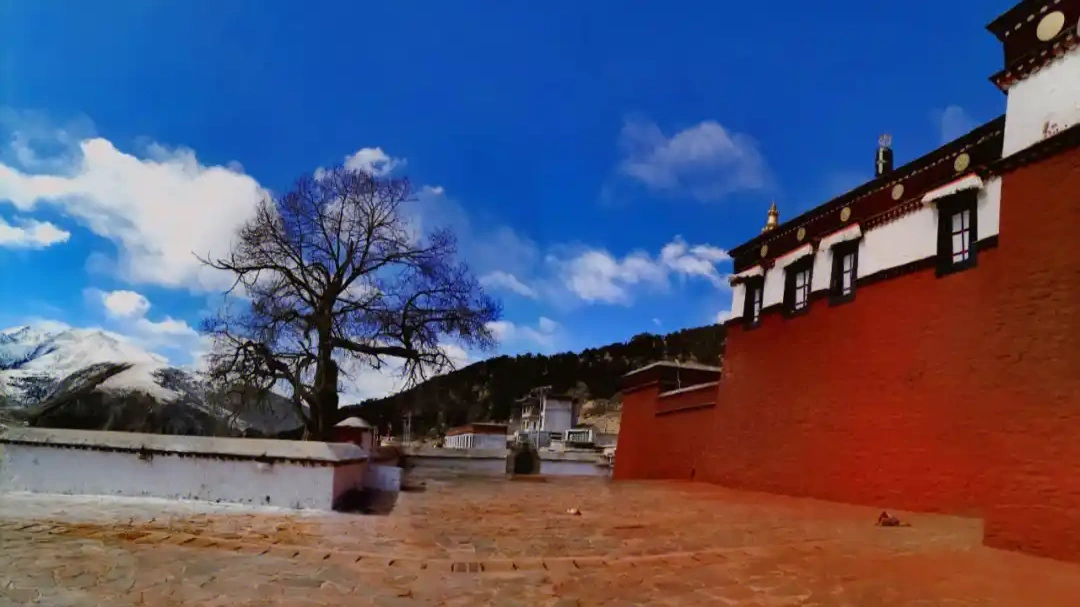 Resing monastery, founded in 1056 by Dom Dunba the disciple of Jowo Jee Palden Atisha the founder of the "Kadampa Sect", has a history of more than 900 years. It is the first temple of the "Kadam Sect" in Tibet, and is located in Tanggu Township, Lindu County, 240 kilometers north of Lhasa city. One way to the monastery has around 160 Km and its over 4230m above sea level. The mountain up there is totally different with other mountain around this village. It was is cover by the juniper tree and can say it is the heaven of the birds. The site is one of the most beautiful in the region. And there is a also nunnery called Samdening over the monastery about 5 -6 Km hiking was amazing that you cant believe that people can live such a place cover with nature and by the wild. There are 125 nuns who live for retreat since from 15th century because the place here was found by the follower of Atisha master the Tsongkapa mater and his first teaching of Gelukpa was also take place up there. Our lunch can be in local restaurant before hiking to the nunnery and drive back to Lhasa after nunnery. Will be the meaningful and unbelievable day.
About the Festival of the Reding monastery
Every year on April 15th of the Tibetan calendar, it is the most exciting and grand day of the "Pabang Dangkuo Festival". The morning "horse racing" and "gunslinging" activities were thrilling. The racecourse is located on the north side of the Panshi Grassland, and before the race, the riders have to ride their horses around the burning mulberry fireworks for a few laps to bring good luck. According to traditional practice, there must be a white horse among the horses participating in the competition, and the riders' competition attire must also be white. During the competition, the rider in white clothing and the white horse must reach the finish line first to show good luck. The crowd watching on the racetrack formed two long human walls. Whenever riders dressed in various costumes and wearing pointed hats waved their whips and rushed past, it would cause waves of astonishment and cheers. After the horse race, the high monks of Rerding monastery will present prizes and offer Kada to the winners. At after- noon, it is said that the ten thousand goddesses led by the dense blank line mother Tujini set up the altar of "Reding Pabang" and began the ritual of serving the master and reciting scriptures. In front of the tents of the chanting lamas, there is a stone altar dedicated to offering sacrifices, which is called 'Tso'. The "Tso" is roughly trapezoidal in shape, decorated with butter flowers on the surface to form a lace, and the middle part shows a cyclical pattern. There is a skinned whole sheep enshrined in front of the pattern. "Tso" is red, and rows of "Torma" tsamba balls are placed on it. Surrounding the "Tso" are various offerings offered by believers, and the finely crafted "Tso" attracts the monks and believers. The lamas of Reding monastery are reciting the sutras of "The Great Master's Offering" in their tents. The crowd outside the tent anxiously waited to share even a small offering, people flocked to the "Tso". Those who grabbed it were happy and brought it home for their relatives and friends to share. The festival is a very ancient and unique art in Tibet's traditional national culture. That wonderful imagination and touching storyline have attracted generations of monks and laypeople. The ritual dance of the the Reding monastery is one of the four offerings of the Gadang school, and is a pioneering work of the yogi "Ami Qiangjiu Renchen". It is said that there was originally only one form of jumping. In the 20th year, Reding Living Buddha dreamed of a god dancing, and since then, he has added many jumping programs on the basis of the original jumping program. In 1604, the fourth Panchen Lama, Lobsang Choejee, went to the Reding Monastery to give a lecture and in the later fifth Panchen Lama served as regent, he also learned to dance gods from the Tse Gongtang Temple and the Namgyal Tazang in the Potala Palace. In short, after several years of evolution and development, the number of dance gods offered outside the Reding monastery has increased to twelve, with extremely rich content. The jumping site of Reding monastery is backed by a Mani wall inlaid with stone carvings, facing a large slope, which is convenient for the audience. The team of jumping gods is composed entirely of young lamas from Reding monastery with the ups and downs of the Dharma horn and drum music, each group of jumping god rituals is colorful and vivid. People can understand the emotions of truth, goodness, and beauty, as well as the good wishes of exorcising demons, subduing demons, and promoting Buddhism from various dance moves, masks, and ghost and god forms. The traditional performance of jumping gods has won rounds of applause from the audience. People's various expectations are fulfilled in the devout prayers, the roaring sound of drums and instruments, and the thumping dance of jumping gods. The "Pabang Dang Gao Jie" also came to an end in that rough and rustic dance posture.
Resing monastery, founded in 1056 by Dom Dunba the discipleof Jowo Jee Palden Atisha the founder of the "Kadampa Sect", has a history of more than 900 years. It is the first temple of the "Kadam Sect" in Tibet, and is located in Tanggu Township, Lindu County, 240 kilometers north of Lhasa city. The mountain over there is totally different with other mountain around this village. It was is cover by the juniper tree and can say it is the heaven of the birds. The site is one of the most beautiful in the region. And there is a also nunnery over the monastery about 5 -6 Km hiking was amazing that you cant believe that people can live such a place cover with nature and by the wild. There are 125 nuns who live for retreat since from 15th century because the place here was found by the follower of Atisha master the Tsongkapa mater and his first teaching of Gelukpa was also take place up there.
Resing monastery, founded in 1056 by Dom Dunba the discipleof Jowo Jee Palden Atisha the founder of the "Kadampa Sect", has a history of more than 900 years. It is the first temple of the "Kadam Sect" in Tibet, and is located in Tanggu Township, Lindu County, 240 kilometers north of Lhasa city. The mountain over there is totally different with other mountain around this village. It was is cover by the juniper tree and can say it is the heaven of the birds. The site is one of the most beautiful in the region. And there is a also nunnery over the monastery about 5 -6 Km hiking was amazing that you cant believe that people can live such a place cover with nature and by the wild. There are 125 nuns who live for retreat since from 15th century because the place here was found by the follower of Atisha master the Tsongkapa mater and his first teaching of Gelukpa was also take place up there.
Breakfast
Overnight at Lhasa
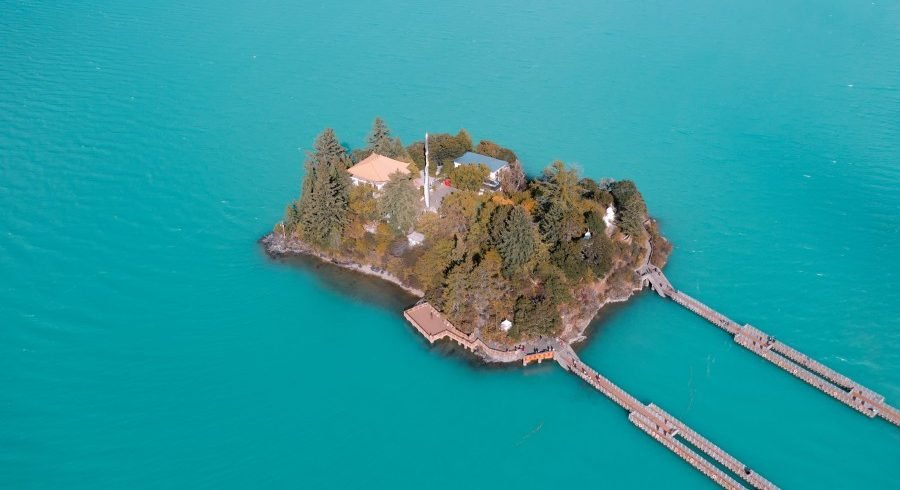
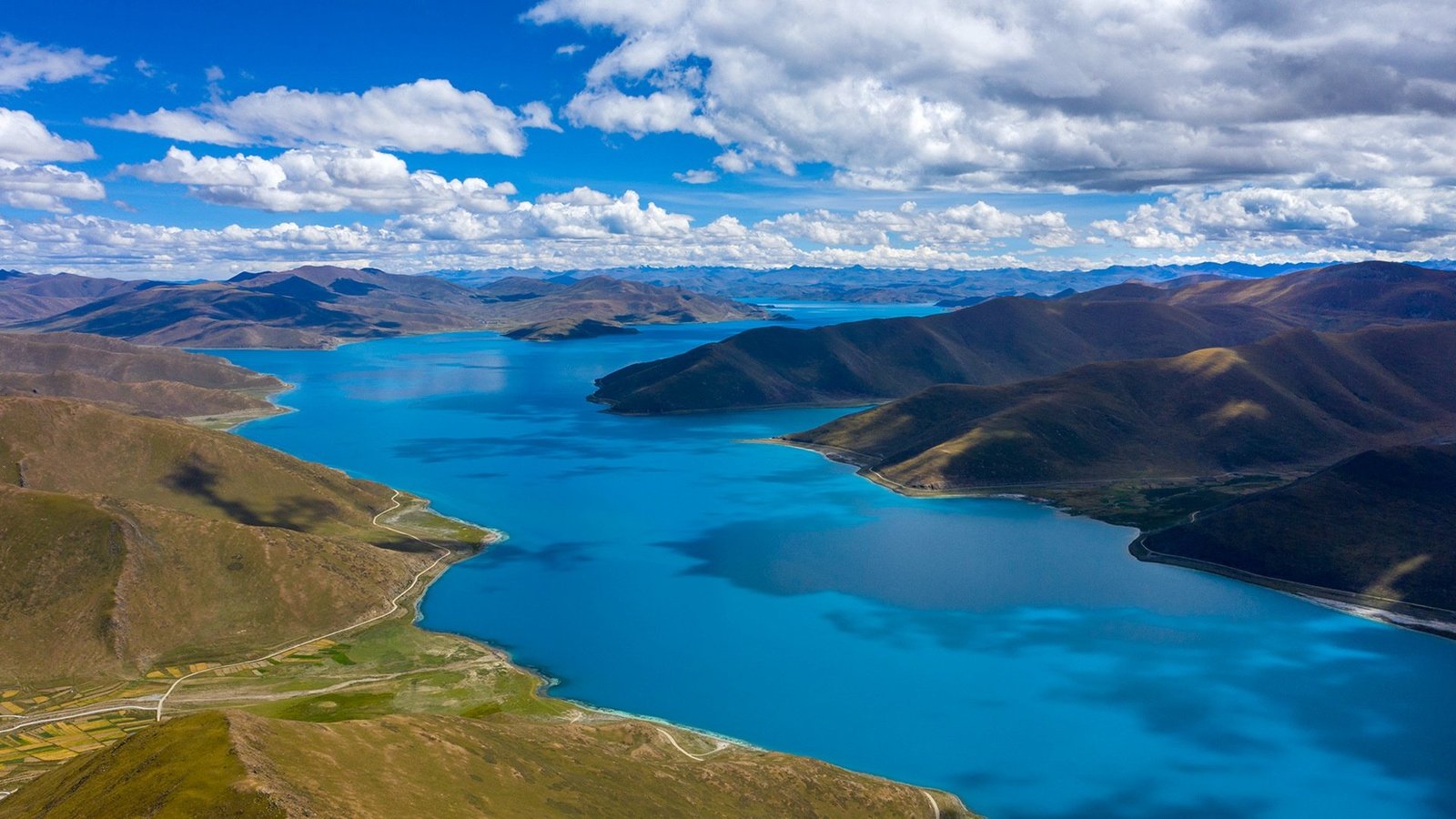 Today is time to say Good bye to Tibet, in order to comeplete the Tibet tour, we designed Tibet Yamdrok Yongtso Lake for you on the last day then drive to Lhasa airport or train station on time.
Yamdrok Yongtso, which means "jasper lake" in Tibetan, is located in Gongga County and Langka County, Shannan City, Tibet Autonomous Region, next to the Yamdrok lake Scenic Area of Provincial Highway 307, and is called the three holy lakes in Tibet together with Namtso and Manasarovar. The lake covers an area of 638 square kilometers. Yamdrok Yongtso is the largest enclosed inland lake in the southern part of the Qinghai Tibet Plateau, with an elevation of 4441 meters, an average depth of about 23.6 meters, a water storage capacity of about 16 cubic kilometers, a shoreline of 250 kilometers, a drainage area of 6100 square kilometers, and a lake water reserve of about 16 billion cubic meters. According to observations and calculations by the local forestry department, the bird islands and bird populations in Yamdrok Yongtso Lake are rare in the country. On these islands, various bird species are found and inhabit. In addition to birds, there are extremely rich species of wild animals inhabiting the Yamdrok Yongtso Lake basin, including mammals such as snow leopards, argali, diarrhea, otters, wild donkeys, rock sheep, yellow sheep, and deer, which are classified as national first and second class protected animals. Yamdrok Yongtso is a unique natural scenic spot integrating plateau lakes, snow mountains, islands, pastures, hot springs, wild animals and plants, temples and other landscapes. It, together with Namtso and Manasarovar, is known as the three major heavenly lakes in Tibet. There are also perennial insoluble snow mountains and ice peaks around, the highest of which is more than 7000 Lakes, snow capped peaks, and blue sky blend together meters above sea level.
By driving along the Lake and village for an hour then drive to Lhasa airport or train station send off.
End the Tour
Breakfast
| Class/Price for P.P | 2024.04.01 ~2024.04.30 | 2024.05.01~2024.06.30 2024.10.08 ~2024.10.31 | 2024.07.01 ~2024.10.07 | 2024.11.01 ~2025.03.31 |
| Economic Class (3-Star Hotels) | USD634 | USD710 | USD743 | USD604 |
| Comfortable Class(4-Star Hotels) | USD680 | USD753 | USD796 | USD649 |
Cost
- Lodgings 4 Nights, twin room en suite in 3★/4★;
- Meal 4 Breakfasts, 1 Lunch and 1 Welcome Dinner
- Transport *Licensed vehicle according to group size & season as itinerary needed;
- *Gas and parking fee for the vehicle;
- *Lhasa Railway Station:
- 1-time free pick-up at any time on Day 01;
- 1-time free drop-off at any time on Day 05;
- *Lhasa Airport:
- 1-time free pick-up at 9:30am、13:00pm、16:00pm from Lhasa Airport on Day 01;
- 1-time free drop-off at 8:30am、12:30pm、14:30 from hotel in Lhasa on Day 05;
- Guide Experienced local English-speaking tour guide
- Admissions All entrance fee mentioned in itinerary
- Permit Tibet Tourism Bureau Permit (TTB);
- Others Travel Agency Liability insurance;
- Government Tax;
- Express delivery fee of Permit (eg. SF. Express)
- Oxygen tank for emergency use;
- Two bottles of mineral water per person per day;
- *Private Lhasa Airport transfers if your flight isn’t within our free service time.
- Nov-Apr: USD 50/vehicle/time
- May-Oct: USD 65/vehicle/time
- *Private Lhasa train station transfers if your train isn’t our group date. USD30 per transfer.
- *Air or Train to/from Tibet
- *China Visa
- *Lunch, Dinner
- *Admission fee for optional attraction
- *Super-fast express delivery of Tibet Entry Permit (eg. China Air Express)
- *Additional days caused by unexpected nature disasters. eg.Land Slide, Avalanche, etc.
- *Gratuities for guide & driver, abt CNY 50/day for both of them together
- *Personal expenses
- *Personal travel insurance
- *Anything not listed in INCLUSIONS