
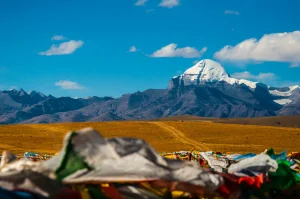
Kailash, a sacred mountain standing in the Alii region of Tibet, is like a bright pearl, exuding a mysterious and fascinating charm.It is regarded as the centre of the world by many religions and is the holy land in the hearts of countless believers. When you set foot on this land and start the journey to turn the mountain, it is as if you have stepped into a sacred and transcendent world.Today, I will share this kailash mountaineering guide with you, hoping to help you start an unforgettable journey.
How to arrive
To travel to Kailash, most people will choose to depart from Lhasa. There are flights from Lhasa Gongga Airport to Kunsha, Ali, but the price of the ticket is high and it is easy to have plateau reaction after getting off the plane, so it is not recommended. If you want to save money, there is a hard-seat shuttle bus from the Lhasa North Suburb Bus Station to Plain County in Ali at 11am every day, via the town of Tarchen, where Kailash is located. However, due to the long distance of 1,500 kilometres, it’s best to charter a bus or take a self-drive tour, which allows you to be flexible and enjoy the breathtaking scenery along the way. If you have fewer travellers, you can also join a group on our platform.
Preparation for mountaineering
Travel Permit
You need to apply for a border pass for travelling to Kailash, which is free of charge in Lhasa and can be picked up in one day . If you are travelling with a group, our travel agency will help you to get one. Of course, you can also do it in advance at the place of residence.
Understanding the custom of mountaineering
Don’t get confused between the clockwise route of Tibetan Buddhism and the anti-clockwise route of Bön Buddhism. The Year of the Horse is the peak season for mountain-turning, and a large number of believers will come in the ‘Year of the Sheep to turn the lake, the Year of the Horse to turn the mountain’.
Consider physical condition
The altitude of the whole journey is over 4,500 metres, with the highest point, Drolma La Pass, reaching 5,630 metres. If you have a strong plateau reaction in Lhasa, it is recommended to travel with caution, after all, safety is the first priority.
Outward Bound Route Details
There are two types of mountaineering: outward and inward, and most tourists choose the outward one. The outward turn is about 56 kilometres, and there are a number of supply points along the way, so it is recommended that you pack light.
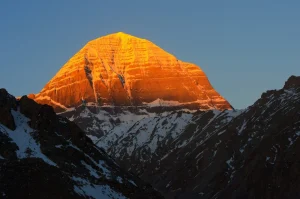
From the town of Tarchen, you will first arrive at the ticket gate. After the checkpoint, you will arrive at the Warp Square after 7 kilometres. This is also a burial ground, which is the starting point of the real mountaineering. Standing here, look up, you can see the majestic summit of kailash, pyramid-shaped mountain in the sunshine shining with the divine light, as if in the call of every pilgrim.
Continuing along the Lachu River, on the left is the Qugu Monastery (Qugu Gompa), which you can visit if you have enough time. After this, the trail goes on for 11 kilometres to the Dira Puk Monastery. This part of the trek is through a canyon, with no view of kailash, but the route is gentle and there is a resupply point on the way. These are tented kiosks where you can refresh yourself with a pot of hot tea or a steaming bowl of instant noodles.
Dira Puk Monastery is at an altitude of 5080 metres, where you can see the north side of Gon Rinpoche. In addition to tents for rent, there is also the Shishapangma Guesthouse, where most people will choose to stay.
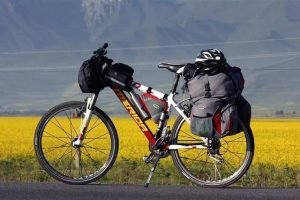
Continuing on from Dira Puk Monastery., the altitude continues to climb and the road becomes gravel when you reach the vicinity of the Sky Burial Plateau. The trail ends here if you have permission to drive. A further 4 kilometres onwards, we reach the most difficult part of the trek, the Drolma La Pass, at an altitude of 5,648 metres. Climbing the Drolma La Pass is a long and arduous process that requires a great deal of perseverance and physical strength. During the climb, every step seems to challenge the limit of the body, but when you finally stand on the pass, overlooking the magnificent scenery around, the sense of achievement and shock is beyond words.
After crossing the pass, it is all the way downhill. Not far ahead, you will see a beautiful sea called Compassion Lake. Here there is a fork in the road can go to the lake, the lake is crystal clear, reflecting the surrounding snow-capped mountains and the blue sky, like a beautiful picture. Continuing 6 kilometres from Cibei Lake, you will arrive at Fudidin, where you can rent tents for camping. Five kilometres further on, there is a teahouse where you can rest your feet if you are tired of walking. Cute groundhogs are often seen along this section of the trail, and their innocent looks add a lot of fun to this arduous journey. Continuing for another 5 kilometres, you will come to the Zuchu Monastery, where you can also hire a tent for camping.
6 kilometres on from Zutshu Monastery, you will reach the end of the trail at Dzongdup Tea House. This is 4km from Tachin, so if you are not feeling up to it, you can take the 60RMB scenic bus back to Tarchen.
Mountaineering time planning
It usually takes two days to complete a round trip, although a few physically fit people can do it in one day, and those who are a little less fit can do it in three days.
Day Trip: Depart Tarchen at 4 or 5am and return to Tarchen at around 10pm, covering 56km. This is a very physically demanding trip, so make sure you take reasonable breaks and remember to bring a torch as it will be dark by the time you return at night.
Two-day itinerary: The first day departs at 9am and arrives in the afternoon at the Chorten Monastery, a journey of 22km, with accommodation at the Shishapangma Guesthouse. In the evening, if the weather is good, you will be able to photograph the beautiful starry sky. Day 2: Depart Shigatse at 5am and return to Tachin at around 8pm, a total of 34km. Sunset is late in Tibet and you can usually make it back before dark.
Three-day itinerary: The first day is the same as the two-day itinerary, with a 9am departure and an overnight stay in Shigatse. The second day starts at 8am and arrives at Tsultrim Monastery at around 6pm, covering 22km and staying in tents nearby. Day 3 is a relatively easy day with only 12 kilometres left to cover and an easy return to Tarchen.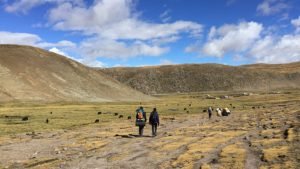
Tips:
Equipment: There is a big temperature difference between morning and evening, the rented tents are not very hygienic, it is recommended to bring your own sleeping bag. Bring a big backpack with you when you go out, store the big backpack at the inn when you turn to the mountain, and use the small backpack to carry the necessary items for travelling. In addition, knee pads, hiking poles, rechargeable batteries, mackintoshes or punching jackets and trousers, bandanas or woolen hats, headlamps and other equipment are essential.
Dietary Supplies: Food supplies are limited on the way to the turnpike, so it is recommended to prepare high-calorie food such as chocolate, biscuits, sugar, etc. in advance, as well as carry enough drinking water. On the second day there are no food supplies until the immovable nails, make sure to bring at least four protein bars, four energy gels, a box of glucose and a canister of oxygen.
Accommodation: the mountain accommodation is more difficult, mainly tents, a small number of small hotels. If you arrive before 5:30pm, you can stay in a triple or quadruple room (public toilets), with electric blankets, and only need to bring a dirty sleeping bag. Electricity is available at 8:30pm, dinner is a five-course buffet, breakfast is served at 6:30am with steamed buns, porridge and eggs, and if you want to leave early you can make your own noodles.
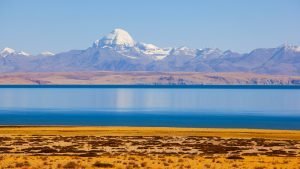
Best time: the best time to turn the mountain is 8, September, when the climate is relatively mild, the scenery is also very charming. Not far from the opposite side of the Kailash is the Monasarovar, don’t miss, the two and called ‘the Zong of a thousand mountains, the source of ten thousand waters’.
Set foot on the road of transmigration of Kailash, is a body sharpening, but also a baptism of the soul. On this sacred land, every step seems to be in dialogue with heaven and earth, and every breath can feel the power of faith. I hope this guide can help you to open your own mountaineering journey, harvest a lifetime of unforgettable experience.
